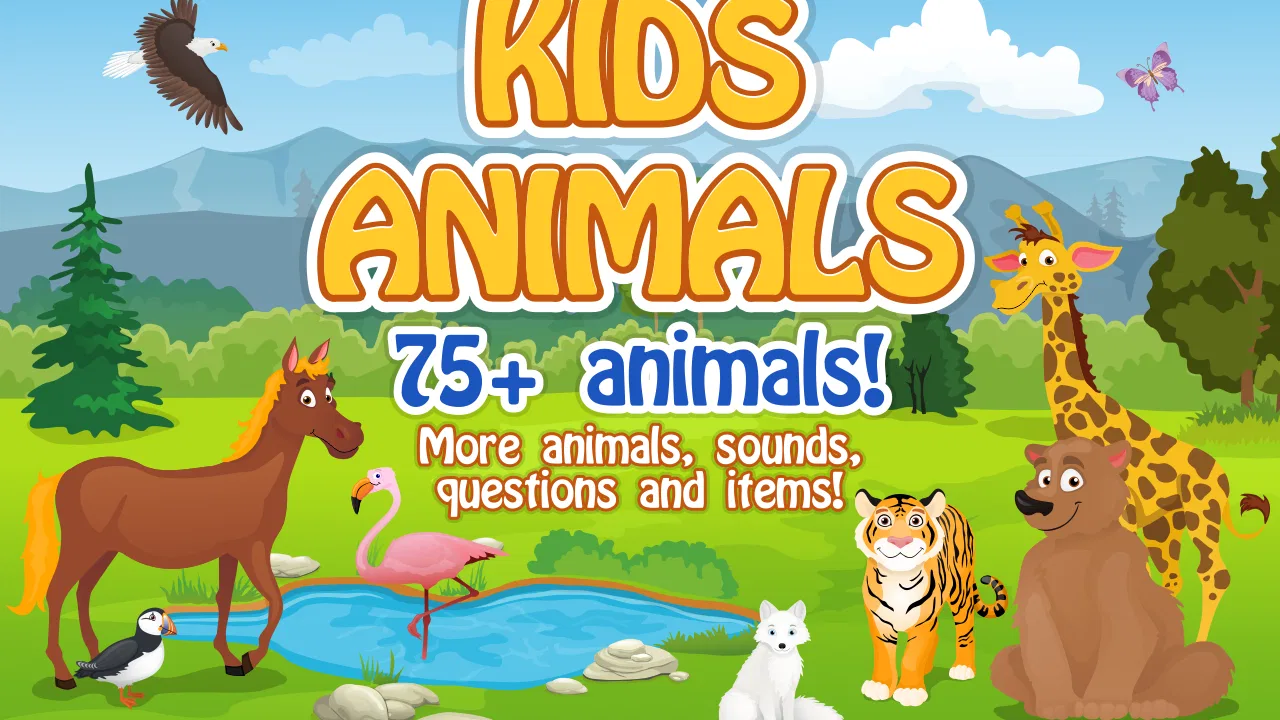
Kids Learn about Animals
- 4.1
- Rating
- 10.00K
- Installs
- $2.99
- Price

 Analysis by App-foxy
When I first opened Kids Learn about Animals, I understood its appeal quickly: it is a focused educational game for children who are beginning to recognize animals and connect them with simple names and sounds. It does not try to be a complete preschool curriculum, and that is part of its charm. The experience is narrow enough for a child to understand without much help, while still giving parents a simple activity to return to during a quiet moment.
This is a paid game from Intellijoy Educational Games for Kids, listed at $2.99 and rated for Everyone. It has reached over 10K installs, with an average rating of 4.1 from around 500 ratings. Those figures suggest a modest but established audience rather than a huge entertainment franchise. In my view, that fits the product well: it feels like a small, purposeful learning tool rather than an app designed to keep a child busy for hours.
What the first session feels like
The most useful way to approach this game is as a short, guided learning activity. I would not install it expecting complex levels, competitive scoring, or the variety of a full children’s game collection. Its value comes from repetition and recognition. A young child can look at an animal, hear or identify its name, and gradually build a connection between the picture and the word.
You May Also Like

 Pandora - Music & Podcasts
Pandora’s Music Is Easy to Start, but Harder to Recover
Pandora’s strength is its low-effort path from a seed to a station. Its weak spot is how much confidence it asks you to place in connection, setup, and quiet recovery.

 8 Ball Pool
 Is Built on Rivalries, Rematches, and Routine
A close look at the rivalries, rematches, shared routines, and unanswered safety questions that turn a quick pool match into a persistent mobile community.

 Samsung Music
’s Quiet Strength Is Playing What You Already Own
Its reach comes less from spectacle than from dependable access to a personal library. That simplicity is both the app’s strongest retention engine and its ceiling.

 AccuWeather: Weather Radar
AccuWeather Review: A Quick, Clear Forecast for Everyday Decisions
For everyday plans, the best forecast is the one you can understand quickly. AccuWeather makes rain timing, radar, and local conditions easy to act on, with a few trade-offs.

 Hill Climb Racing
Why Hill Climb Racing Still Turns Crashes Into One More Run
A tiny car, a bumpy hill and one more upgrade: Hill Climb Racing keeps resurfacing because its simple chaos makes every near-miss feel personal.

 AliExpress - Shopping App
AliExpress Makes Global Shopping Feel Personal, but Shoppers Bear the Risk
AliExpress turns a global marketplace into a pocket-sized discovery engine. Its reach is useful, its shopping loop compelling, and its trade-offs easy to miss.
More From Our News Desk
View All News


That makes it especially suitable for children who are still developing vocabulary, children learning English as an additional language, or preschoolers who enjoy animals and respond well to visual prompts. Parents can sit beside the child at first, but the basic idea is accessible enough that many children can explore it with limited assistance once they understand what to tap.
The store summary presents it as a favorite animals game for kids, but I would describe it more carefully. It is best when used in short sessions with a clear purpose: naming familiar animals, introducing less familiar ones, practicing listening, or encouraging a child to speak aloud. It is not a replacement for books, real-world observation, or conversation with an adult. Instead, it works as a convenient extra prompt between those richer activities.
Before handing over the device, I recommend deciding what success will mean for your child. For one child, success might be correctly recognizing a dog or cat. For another, it might be attempting to repeat a new animal name. This small change in expectation matters because the game is more rewarding when the adult watches for learning rather than simply counting how long the child stays engaged.
Getting ready without turning setup into a lesson
The game is currently listed as version 2.4.3 and requires an operating system of 7.1 or later. I would check compatibility before purchasing, particularly if the app is intended for an older device kept for children. Once installed, the best first step is not to explain every possible interaction. Open it with the child, point out one animal, and invite a response. Too much instruction can make a simple activity feel like homework.
Because the price is a one-time $2.99 purchase, it may appeal to parents who prefer a small paid app over filling a child’s device with advertising-supported games. Still, I would make the purchase decision based on your child’s age and interests. If animals are not already motivating, the educational value may be limited no matter how simple the interface is.
I also suggest preparing the device for shared use. Lower the volume if the child is playing near others, keep the screen at a comfortable distance, and decide whether the session will happen at a table, in the car, or during a transition between activities. The game is most effective when the child can hear the animal names clearly and has enough time to respond without being rushed.
A useful setup habit is to begin with an adult demonstration that lasts only a few seconds. Tap through one example, say the animal name naturally, and then give the device back. Avoid answering every prompt immediately. A pause gives the child a chance to look, think, and speak. That pause is where much of the learning happens, even though it is easy for a busy adult to fill it.
Reaching the first meaningful success
The first successful action should be deliberately small. Ask the child to identify one familiar animal, then celebrate the attempt rather than demanding perfect pronunciation. If the child says only part of the word, repeats a sound, or points correctly, I would treat that as progress. The game supplies the visual focus; the adult supplies the encouragement and language model.
For a child who is shy about speaking, begin with recognition. Ask, “Can you find the animal?” or “Which one is this?” If speaking is already comfortable, ask a slightly richer question, such as whether the animal is large or small, where it might live, or what sound it makes. These questions do not require the game to contain extra activities; they turn each screen into a starting point for conversation.
One of my favorite ways to use an animal-learning game is to connect the digital image with something outside the screen. After a session, look for the same animal in a picture book, on a walk, in a toy box, or in an ordinary conversation. The child then learns that the word is not tied only to a particular picture on a phone or tablet. This transfer from screen to daily life is more valuable than simply completing another round.
Keep the first session short enough that the child finishes wanting another turn. A child who stops after a successful answer is often in a better position than one who continues until attention disappears. I would also avoid using the game as a reward for every routine task. It works better as a predictable learning moment than as a bargaining tool.
Where parents may see confusion
The main point of possible confusion is the difference between tapping and learning. A child may quickly discover that touching the screen produces a response, but that does not necessarily mean the animal has been understood. Watch whether the child can name or recognize the animal after a brief pause, and occasionally ask about it away from the device. That simple check tells you more than speed.
Another common issue is assuming that a child’s silence means failure. Some children need time to process a new word, especially when the animal is unfamiliar or the pronunciation is difficult. I would repeat the word clearly, use it in a short sentence, and move on without pressure. Returning to it later usually works better than turning one item into a test.
Parents should also be aware that animal recognition is not the same as broad language development. A child may memorize several labels while still needing help with sentence building, listening, turn-taking, and describing what they see. This game can support those skills when an adult talks alongside it, but it cannot provide the full range of interaction that a parent, teacher, or playmate offers.
There is also a practical trade-off in the narrow focus. Children who love animals may stay interested longer, while children who prefer vehicles, letters, numbers, or pretend play may lose attention quickly. That is not a defect in the animal theme, but it does mean the app is not an automatic fit for every preschooler. If your child already enjoys naming animals, the focused subject is a strength. If not, a broader learning app may be a better first purchase.
The age rating of Everyone makes the game easy to consider for family use, but age labels do not tell you exactly how independently your own child will manage it. A toddler may need an adult to interpret the task, while an older preschooler may want more challenge than simple recognition provides. I would judge readiness by whether the child can follow a basic visual prompt and remain interested in a short activity, not by age alone.
Using repetition without making it dull
Repetition is essential for early learning, but repeating the same interaction in exactly the same way can become passive. I recommend changing the adult’s role from session to session. One time, focus on saying the names. Another time, ask the child to listen carefully. Later, pause before the answer and invite the child to predict what comes next. The app remains the same, but the mental task changes.
A particularly useful routine is “look, say, connect.” First, let the child look at the animal. Next, encourage the name. Finally, connect it to a real-world detail: a habitat, a movement, a sound, a book, or a personal experience. This takes only a few seconds, yet it prevents the activity from becoming a sequence of isolated labels.
You can also use the game with two children, provided the older or more confident child does not answer everything. Give each child a turn to point or name an animal, and ask the listener to repeat it. This turns a solitary app into a small cooperative language activity. I would keep the turns brief, because competition can easily replace learning when one child is much faster.
For children learning English, the game may be useful as a pronunciation prompt, but I would not correct every sound. Model the word naturally and let the child try again when willing. If a word is difficult, pair it with a gesture or a picture in a book. The goal is meaningful recognition first, with clearer pronunciation developing through repeated exposure.
How it compares with the usual alternatives
Compared with a printed animal book, this game offers a more interactive way to hold attention, especially for children who want to touch and receive an immediate response. A book is usually better for longer conversations, richer illustrations, storytelling, and following a child’s curiosity in any direction. I see the app as a useful companion rather than a substitute. A short game session followed by a book can work better than either one alone.
Compared with a video, the game gives the child a more active role. A video can show movement and offer a wider sense of the animal world, but it is easy for a child to watch without responding. Here, the parent can pause, ask questions, and wait for an answer. On the other hand, families looking for realistic footage, music, or a longer narrative will probably find a video more engaging.
Compared with a broad preschool learning suite, this title is simpler and more limited in subject. That simplicity can be a benefit for a first-time user who becomes overwhelmed by menus, multiple subjects, and reward systems. It is less suitable for a family wanting letters, counting, puzzles, drawing, and animals in one place. In that case, a larger educational collection may offer better variety, even if it feels less focused.
Compared with free animal games, the paid price may be a reasonable trade-off for parents who want a more contained experience and do not want the child browsing through unrelated content. I would still compare the actual interaction style with your child’s needs. A free activity that encourages more conversation may be more valuable for your family than a paid game that your child opens once and abandons.
Who will get the most from it
I would recommend this game most readily to parents of young children who already show interest in animals and need a calm, straightforward way to practice names. It can also suit caregivers looking for a short activity during a waiting period, a rainy afternoon, or a transition when a child needs something familiar but not overly complicated.
It is particularly helpful when an adult is willing to participate for at least part of the session. Even a few questions can turn recognition into language practice. If you plan to give the device to a child and expect the app to teach everything independently, the results may feel less impressive. The strongest use is guided independence: the child explores, while the adult occasionally prompts, listens, and connects the lesson to real life.
I would skip it if your child needs advanced challenges, open-ended creativity, or a wide range of subjects. I would also hesitate if the child has no interest in animals and you are hoping the theme alone will create motivation. In that situation, an app built around the child’s existing interests may produce more genuine practice.
My recommendation after regular use
Kids Learn about Animals is a compact educational game with a clear purpose. Its strongest quality is that a first-time user can understand the basic idea without a long explanation, and a parent can turn a simple animal prompt into a useful conversation. Its limitations are equally clear: the subject is narrow, the learning depends heavily on repetition and adult involvement, and children seeking deep variety may outgrow the experience quickly.
For a first session, I would install it on a compatible device, demonstrate one interaction, and let the child attempt a familiar animal without interruption. After that, I would use short sessions, vary the questions, and connect the animals to books, toys, outdoor observations, or family conversation. That approach gives the app a role that is realistic and worthwhile.
My final opinion is positive, with reasonable expectations. At $2.99, it makes the most sense for a child who is already curious about animals and benefits from visual repetition. I would not present it as a complete learning solution, but I would recommend it as a gentle starting point for building animal vocabulary and confidence. The best result is not a child who taps through everything quickly; it is a child who closes the game and recognizes the same animal in the world around them.
Best suited to short, shared learning moments rather than long unsupervised play. That is the mindset I would bring to this game, and it is the reason I think it can earn a useful place on a family device.
FAQs for Kids Learn about Animals
01What is Kids Learn about Animals?
Kids Learn about Animals is an educational app designed to introduce children to different animals through colorful images, simple descriptions, and interactive learning activities. It may help young learners recognize animals, discover where they live, and learn basic facts about their appearance, sounds, and behavior in a more engaging way than traditional reading alone.
02What age group is Kids Learn about Animals suitable for?
The app is mainly suitable for preschool and early elementary-school children who are beginning to explore the world around them. The simple presentation and visual content can be useful for children who are still developing reading skills, although parents should review the activities themselves because learning levels, language abilities, and the amount of adult guidance needed can vary from one child to another.
03Does Kids Learn about Animals work without an internet connection?
Some parts of Kids Learn about Animals may be available offline after the app has been installed, which is convenient for travel or situations without Wi-Fi. However, availability can depend on the specific version and device. Parents should open the app once while connected to the internet and test the lessons, sounds, videos, or other features before relying on it offline.
04Is Kids Learn about Animals safe for children to use?
The app is intended for children, but parents should still check its privacy details, advertising policy, and any links to external websites before allowing independent use. It is also a good idea to review whether the app includes in-app purchases, notifications, or third-party advertisements. Younger children may benefit from supervised sessions so the learning experience remains focused and age appropriate.
05Does Kids Learn about Animals include quizzes or interactive activities?
Kids Learn about Animals may combine animal information with interactive elements such as picture selection, matching tasks, sound recognition, or simple quizzes. These features can make learning more memorable and help children check what they have understood. The exact activities may differ by platform or app version, so users should review the current store listing before downloading to confirm the available content.
Pros
- Simple lessons help children recognize common animals quickly.
- Bright illustrations make the learning experience appealing to young users.
- Short activities are suitable for brief practice sessions.
- Useful for introducing animal names and basic vocabulary.
- Can support early learning at home or during travel.
Cons
- Content may feel too basic for older children.
- Limited variety could reduce replay value over time.
- Some activities may become repetitive after frequent use.
- Learning progress may be difficult for parents to track.
- Requires adult guidance for children who cannot read yet.

Kids Learn about Animals
Gallery